
Dental Filling
Composite (white) and porcelain inlay/onlay filling options for cavity treatment. Book an appointment for a permanent dental filling at Emrivadent Antalya.
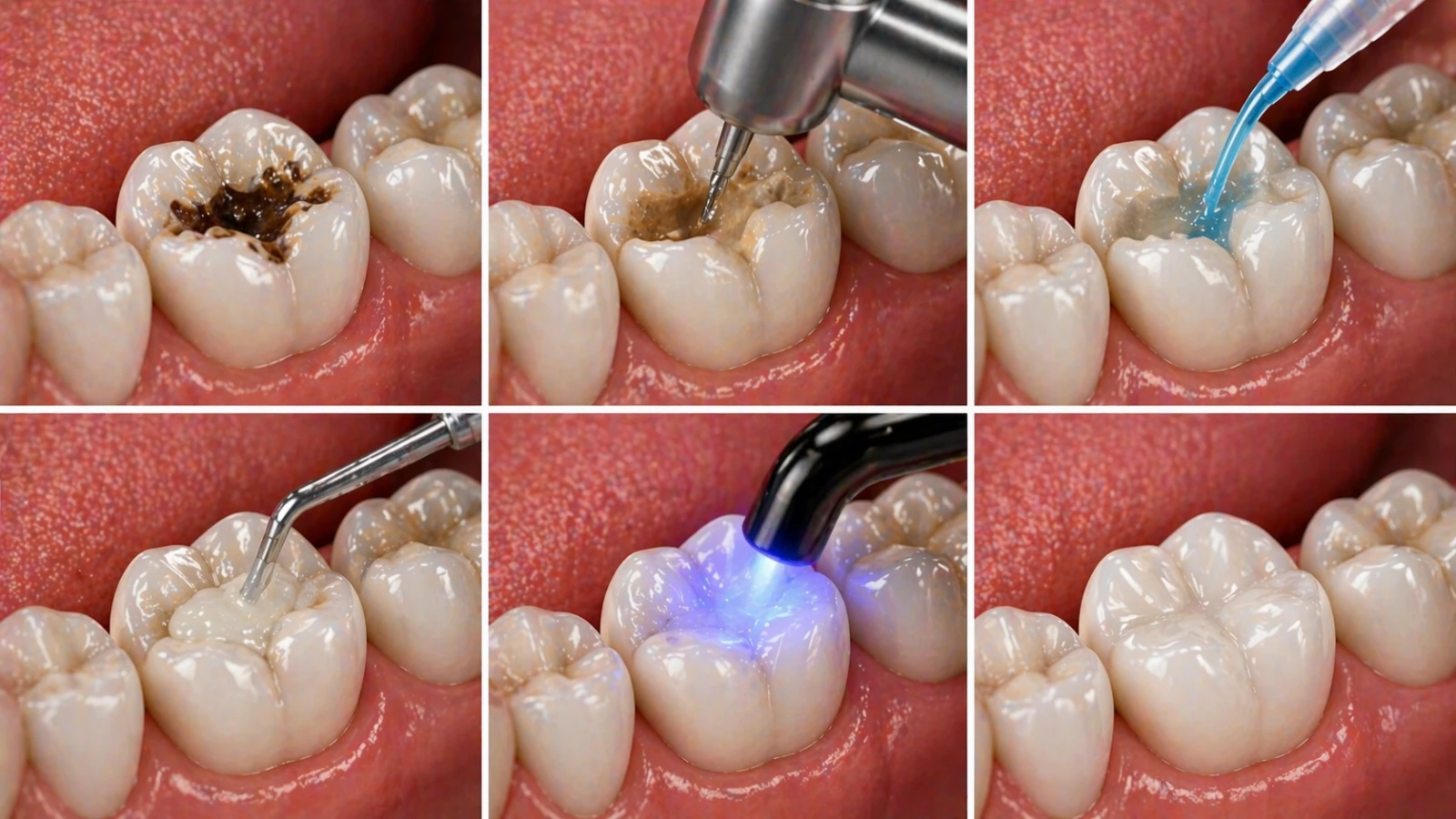
A dental filling is the reconstruction of tooth structure lost due to decay or fracture using composite, porcelain or glass ionomer material. Emrivadent offers aesthetic white composite and CAD/CAM porcelain inlay/onlay options.
Types of Dental Fillings
| Filling Type | Material | Aesthetics | Durability | Application |
|---|---|---|---|---|
| Composite (white) | Resin-based | High | 7–10 years | 1 session |
| Porcelain inlay | Ceramic | Very high | 15–20 years | 2 sessions / CAD-CAM |
| Porcelain onlay | Ceramic | Very high | 15–20 years | 2 sessions / CAD-CAM |
| Glass ionomer | Glass-acid | Moderate | 5–7 years | 1 session (children/temporary) |
Composite Filling Procedure Steps
- Local anaesthesia (if required)
- Removal of decayed tissue (high-speed bur)
- Acid etching and bonding agent application
- Layered placement of composite resin
- Polymerisation with LED light (40 seconds)
- Shaping and polishing
Difference Between Inlay and Onlay
- Inlay: Fillings that fit within the tooth cusps; suitable for small-to-medium cavities.
- Onlay: A filling covering one or more cusps; preferred for extensive cavities or fractured teeth.
Post-Filling Care
- Brushing twice daily and using dental floss
- Avoiding excessively hard and sticky foods
- Dental check-up every 6 months
- Night guard use if bruxism is present
Dental Fillings at Emrivadent
Emrivadent achieves aesthetically superior results with 3M Filtek and Ivoclar Vivadent composite systems. CAD/CAM porcelain inlay/onlay procedures can be completed within a single day.
Frequently Asked Questions
Dental Filling FAQ
Find answers to your questions here

The procedure can be performed completely painlessly with local anaesthesia. Mild sensitivity for 24–48 hours after the anaesthesia wears off is normal. In deep filling procedures, heat or touch sensitivity may last 1–2 weeks.
A quality composite filling lasts an average of 7–10 years. Porcelain inlay/onlay is longer-lasting (15–20 years) for posterior teeth exposed to high chewing forces.
Routine replacement of amalgam fillings that are functionally sound is not recommended. If there is fracture, leakage or aesthetic concern, they can be replaced with white composite or porcelain inlay. Amalgam removal is performed at our clinic using a heavy metal safety protocol.
A classic filling is made by shaping and curing soft material inside the mouth. An inlay is a type of restoration produced in a laboratory and bonded to the tooth, offering greater strength and more precise fit. Inlays are longer-lasting especially for extensive cavities.
After composite filling curing, solid food can be eaten on the same day; however, avoiding very hard and sticky foods for the first 24 hours is recommended. After porcelain inlay bonding, biting forces should be avoided until the cement fully sets (usually 24 hours).